TWO:Sir Robert Wilson, the British Commissioner, urged Kutusoff, indeed, to make one general and determined attack on Buonaparte and this small body before the other divisions could come up; and there can be no doubt that, had he done so, he would have destroyed the division utterly, and made himself master of Napoleon's person. But though Kutusoff had fought the battle of Borodino, he had now grown over-cautious, and did not do that which it was the plan of Barclay de Tolly, whom he superseded, to do when the right moment came. Whilst Kutusoff was thus timidly cannonading, the division of Davoust came up, and he retired, allowing both Buonaparte and Davoust to secure themselves in Krasnoi. As for Ney, he was left behind wholly surrounded by the Russians who had harassed the rear of Davoust, and were thus interposed between Davoust and himself, as well as swarming on his own flanks and rear. Napoleon could not wait for him, even at Krasnoi. He learned that the Russians were drawing fast towards his crossing-places at the Dnieper and the Beresina; that Prince Galitzin with a strong force was about to occupy Krasnoi; that the Dnieper at Liady would be immediately in the hands of the enemy. He therefore called Mortier, and squeezing his hand sorrowfully told him that he had not a moment to lose; that the enemy were overwhelming him in all directions; that Kutusoff might have already reached Liady, perhaps Orcha, and the last winding of the Dnieper was yet before him. Then, with his heart full of Ney's misfortunes, he withdrew, in despair at being forced to abandon him, towards Liady. He marched on foot at the head of his Guard, and often talked of Ney. He called to mind his coup-d'?il, so accurate and true, his courage, proof against everything¡ªin short, all the qualities which made him so brilliant on the field of battle. "He is lost! Well! I have three hundred millions in the Tuileries; I would give them all were he restored to me!"As to the silk and wool trades, in the ten years preceding 1824 the quantity of raw and thrown silk used by our manufacturers was on an average of 1,882,311 lbs. per annum. In the ten succeeding years the average was nearly double, viz. 95 per cent. higher; and in the sixteen years which ended in 1849 there was an increase of 120 per cent. over the quantity used under the restrictive system. According to the report of the inspectors of factories, there were, in 1835, 231 silk factories in England, six in Scotland, and one in Ireland. The total number of females thus employed was over 20,000, and the total number of both sexes was about 31,000. The total number of woollen and worsted factories at work in 1835 was returned by the inspectors of factories as being 1,313, showing an increase of ten per cent. in four years. The total number of persons employed in them in 1835 was 71,274, on which there was an increase of twenty per cent. up to 1839. There was a general depression in the price of British wool, in consequence of which a Committee of the House of Commons was appointed to inquire into the causes. From the evidence which they received, it appeared that the actual number of sheep in England and Wales had increased one-fifth since the year 1800, when it was 19,000,000, yielding about 95,000,000 lbs. of wool, or about five pounds[419] for each fleet. It was estimated that the quantity used for manufacturing purposes increased during the first half of the nineteenth century by 115 per cent. Yorkshire is the chief seat of the woollen manufacture, and the best proof of its progress, perhaps, is presented in the state of the population, which in the whole of the West Riding increased during the first forty years of the century at the rate of 104 per cent. At the census of 1801 it was 563,953, while the census of 1841 showed it to be 1,154,101.
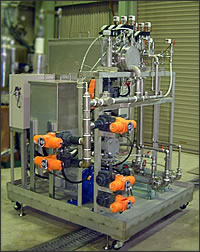
A hydrocyclone (liquid cyclone) injects treatment solution into stationary equipment to perform separation, classification, and concentration, and is an innovative separator with a very simple structure and no drive unit.
Structure of a hydrocyclone (liquid cyclone)
A suspension containing fine particles of several micrometers or more is supplied to a cylindrical container circumferentially at high speed. And as a result it starts to rotate and a centrifugal force is generated. At this time a gravitational acceleration of several tens of thousands of G is generated in the circumferential direction, and thus leading to fast sedimentation and concentration of the fine particles. The separated concentration can be freely selected by changing the supply rate (supply pressure and flow rate) and the flow ratio of the outlet. Our hydrocyclone (liquid cyclone) was designed and manufactured to classify and concentrate fine particles, and so has a small element.
THREE:It was now expected by the Whigs, and by a[10] great part of the public, that they should come into office. At first the conduct of the Prince Regent favoured this supposition. He applied to Grey and Grenville to draw up the answer that he should return to the two Houses on their addresses on his appointment. But he did not quite like this answer, and got Sheridan to make some alterations in it. He then returned the paper to Grey and Grenville, as in the form that he approved. But these noblemen declared that they would have nothing more to do with the paper so altered; and Sheridan, on his part, suggested to the prince that he would find such men as Ministers very domineering and impracticable. Nor was this all¡ªLord Grenville and his family held enormous patronage. Like all the Whigs, the Grenvilles, however they might study the interests of the country, studied emphatically their own. Grenville had long held, by a patent for life, the office of Auditor to the Exchequer; and in accepting office in "All the Talents" Ministry, he managed to obtain also the office of First Lord of the Treasury. The Auditorship of the Exchequer was instituted as a check on the Treasury, but neither Lord Grenville nor his friends saw any impropriety in destroying this check by putting both offices into the same hands. They declared this union was very safe and compatible, and a Bill was brought in for the purpose. But when the King had become both blind and insane, and no Regent was yet appointed, Lord Grenville, being no longer First Lord of the Treasury, but Perceval, he suddenly discovered that he could not obey the order of the Treasury for the issues of money to the different services. It was strictly necessary that the Great Seal, or the Privy Seal, or the Sign Manual, should be attached to the Treasury orders, or, failing these, that they should be sanctioned by an express Act of Parliament. As neither Great nor Privy Seal, nor Sign Manual was possible until a regent was appointed, Lord Grenville's conscience would not let him pass the orders of the Treasury, and all payments of army, navy, and civil service were brought to a stand. Perceval, after in vain striving hard to overcome the scruples, or rather the party obstinacy of Grenville, was compelled to go to the House of Parliament, and get the obstacle removed by a resolution of both Houses. The notice of the public being thus turned by Grenville to his holding of this office, and his readiness to unite the two offices in his own person, which his pretended scruples of conscience now invested with so much danger, produced a prejudice against him and his party, which was hostile to their coming into power. Besides this, the Opposition were greatly divided in their notions of foreign policy. Grey and his immediate section of the party felt bound, by their advocacy of Fox's principles, to oppose the war; Grenville and his friends were for a merely defensive war, and for leaving Portugal and Spain, and the other Continental nations, to fight their own battles; whilst Lord Holland, who had travelled in Spain, and was deeply interested in its language and literature, was enthusiastic for the cause of the Peninsula, and the progress which Wellington was making there. It was utterly impossible that, with such divided views, they could make an energetic Ministry at this moment, and it was equally certain that they could not again form an "All the Talents" by coalition with the Conservatives. And, beyond all this, it does not appear that the Regent was anxious to try them. Like all heirs-apparent of the house of Hanover, he had united with the Opposition during his youth, but his friendship appeared now anything but ardent. Sheridan still possessed something of his favour, and the Earl of Moira was high in it; but for the rest, the prince seemed quite as much disposed to take the Tories into his favour; and he, as well as the royal dukes, his brothers, was as much bent on the vigorous prosecution of the war as the Tories themselves. No Ministry which would have carried that on languidly, still less which would have opposed it, would have suited him any more than it would have done his father. The King, too, was not so deeply sunk in his unhappy condition but that he had intervals lucid enough to leave him alive to these questions, and he showed so much anxiety respecting the possible change of the Ministry, and fresh measures regarding the war, that his physicians declared that such a change would plunge him into hopeless madness and probably end his life. The Queen wrote to the prince, saying how much satisfaction his conduct in regard to these matters had given to his father, and he wrote to Mr. Perceval, declaring that this consideration determined him not to change the Ministry at all. At the same time he expressed to the Minister his dissatisfaction with the restrictions which had been imposed upon him. Perceval, even at the risk of offending the prince, justified the conduct of Ministers and Parliament. In this he might be the more bold, as it was clear that there was no longer any danger of a Whig Government.
- Equipment costs can be reduced.
- Operating costs can be reduced.
- Maintenance costs can be reduced.
- Any change in raw material and product can be easily addressed.
- Large amounts can be treated in a small area.
- Separation and cleaning are easy because of the simple structure.
- Simplified control
- This equipment can be operated in synchronization with external devices.
- Alarm and interlock mechanism.
THREE:The Premier was at this time subjected to a great mortification in being compelled by the House of Commons, and public opinion out of doors, to cancel the appointment of the Marquis of Londonderry as ambassador to St. Petersburg. A deep sympathy with the oppressed Poles, and an abhorrence of the unrelenting despotism of Russia pervaded the public mind in the United Kingdom. The Marquis of Londonderry had distinguished himself by sympathies of an opposite kind, and had characterised the Poles as the Czar's rebellious subjects. It was generally felt that England could not be fairly represented at the Court of St. Petersburg by a man of such well-known sentiments. The press was loud in its condemnation of the appointment, and Mr. Sheil brought the subject before the House of Commons by moving that an Address be presented to his Majesty for a copy of the appointment. As Lord Stanley declared emphatically against the selection of the noble marquis for such a mission, it was evident that if Government had gone to a division they would have been defeated. Sir Robert Peel therefore gave way with a good grace, stating that the appointment had not been formally made out; and though the House seemed to be interfering unduly with the Royal Prerogative, he would not advise his Majesty to persist in it. The motion was then withdrawn, and when Lord Londonderry read the report of the debate in the papers next day, he immediately sent in his resignation. In announcing this in the House of Peers, he said: "Having but one object, and that to serve the king honestly and to the best of my ability, were I to depart from this country after what has passed in the House of Commons, I should feel myself, as a representative of his Majesty, placed in a new, false, and improper position. My efficiency would be impaired, and it would be impossible for me to fill the office to which I have been called with proper dignity or effect. Upon these grounds, I have now to announce that no consideration will induce me to accept the office which his Majesty has been graciously pleased to confer on me."The formidable organisation of the Roman Catholics led to a counter organisation of the Protestants, in the form of Brunswick Clubs. This organisation embraced the whole of the Protestant peasantry, north and south, the Protestant farmers, and many of the gentry. They, too, held their regular meetings, had their exciting[284] oratory, and passed strong resolutions, condemnatory of the inaction of the Government, which was charged with neglecting its first and most imperative duty¡ªthe protection of society from lawless violence. The Brunswickers, as well as the Emancipators, had their "rent" to bear the expenses of the agitation. They alleged that they were obliged to organise in self-defence, and in defence of the Constitution. In Ulster the country was divided into two camps, Catholic and Protestant. Notwithstanding the difference in numbers, the Protestants of Ulster were eager to encounter their antagonists in the field, and had not the slightest doubt of being able to beat them. They had all the proud confidence of a dominant race, and regarded the military pretensions of their antagonists as scornfully as the Turks would have regarded similar pretensions on the part of the Greeks. The feeling on both sides was such, that an aggression upon the Protestants in the south would have called forth 100,000 armed men in the north; and an aggression upon the Catholics in Ulster would have produced a similar effect among the Catholics in Munster. The number of Protestants in favour of Emancipation constituted but a small minority. The great mass were against concession. They believed that an insurrection would be the most satisfactory solution of the difficulty. With the aid of the army they felt that they were able to crush the "Papists," as they had been crushed in 1798, and then they hoped they would be quiet for at least another generation, resuming what they considered their proper position as "sole-leather." They forgot, however, the increase in their numbers, their property, and their intelligence. They forgot the growth of a middle class amongst them; the increased power and influence of the hierarchy, and the formidable band of agitators supplied by the Roman Catholic bar, whose members, many of them men of commanding abilities and large practice, were excluded by their creed from the Bench; which exclusion filled the minds of the ambitious with a burning sense of wrong, and made it their interest to devise all possible modes of evading the law, while keeping the country on the verge of insurrection.
- Classification and concentration for the manufacture of inorganic powder materials
- Classification of ceramic materials
- Removal of fine particles, including iron powder
- Removal of fine particles from pigments
- Removal of fine organic particles from solvents
- Separation of starch and yeast
- Removal of fine particles from high-temperature strong acid solutions
- Removal of fine particles from low-temperature solutions